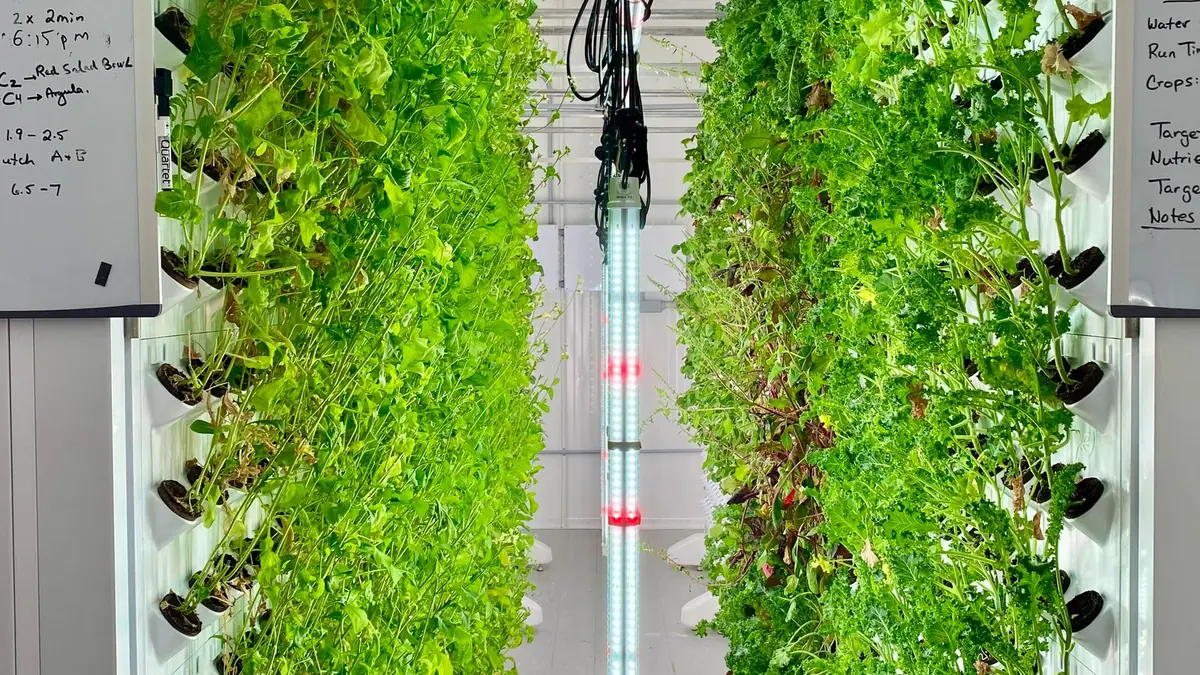
Vertical and indoor farming - growing crops in stacked trays or towers inside a controlled building rather than in open fields - has drawn significant investment in Ohio and across the U.S. This page explains how the technology generally works, using a well-known Ohio example for context.
How indoor vertical farms work
Instead of sunlight and open soil, indoor vertical farms use LED lighting, climate control and either hydroponic or aeroponic growing systems stacked in layers to maximize production per square foot of building space. Growing conditions - light intensity, humidity, nutrient delivery - are monitored and adjusted continuously rather than left to weather.
An Ohio example: 80 Acres Farms
80 Acres Farms, a Cincinnati-based company, broke ground in September 2018 on a fully automated indoor farm in Hamilton, Ohio, which the company described at the time as the first facility of its kind in the United States. The planned build-out covered more than 150,000 square feet across four phases, using robotics, AI-driven controls and continuous sensor monitoring from seeding through harvest. The first phase focused on specialty greens - microgreens, culinary herbs and leafy greens - with planned distribution to regional grocers. Reported project costs for the initial phase ran in the $10-15 million range, supported in part by a local tax abatement.
What vertical farming solves, and what it doesn't
Indoor vertical farms can grow produce year-round close to urban customers, cutting transportation time and reducing exposure to weather-related crop loss. They typically use far less water than open-field agriculture for the same yield of leafy greens, because water recirculates in a closed system. The trade-offs are real: high upfront capital costs, significant ongoing electricity use for lighting and climate control, and a crop mix generally limited to leafy greens and herbs rather than staple grains or root vegetables, which are far less economical to grow this way.
Why several venture-funded vertical farms have shut down
The years since 80 Acres Farms broke ground have shown how capital-intensive this model is. Kentucky-based AppHarvest, which had gone public via a SPAC deal in 2021, filed for Chapter 11 bankruptcy protection in 2023 after facing Nasdaq delisting notices and a creditor move to foreclose on its facility, according to reporting at the time. New York-based Bowery Farming, which had raised substantial venture funding, ceased operations in November 2024, according to TechCrunch, citing rising operating costs and an inability to secure further funding; its Georgia facility has since gone to liquidation. AeroFarms also filed for bankruptcy in 2023 after raising more than $300 million from investors, but it exited bankruptcy protection the same year following a restructuring, according to Food Dive. High electricity costs for lighting and climate control, and outdoor farming's persistent cost advantage, are the reasons most commonly cited in this coverage for the sector's difficulties; they do not by themselves say whether any specific, still-operating company, including 80 Acres Farms, will or won't remain financially viable.
How this compares to traditional growing
Vertical farming is not a replacement for traditional agriculture at the scale needed to feed a region - it is a complement, best suited to high-value, fast-growing, light crops sold close to where they're grown. See hydroponics vs. soil for how the underlying growing method compares at the scale of an individual urban farm, rather than an industrial facility.